On Making Things Up
Pirates, old ghosts, and learning to let go
“It is possible to spend so long imagining a painting that you become reluctant to let the real thing interfere with your imagination.”
I have had a miserable cold for most of the week, which has kept me out of the studio. As a result, I've spent an unusual amount of time reading, writing, and looking at other people's artwork. This is frustrating because October is usually my most productive month. Something about autumn makes me want to paint. The smell of leaves breaking down, the first cold evenings, football on television. I am susceptible to nostalgia this time of year. But lately I have begun to suspect that my October productivity has as much to do with the preceding summer as with the season itself.
Over the summer, a young painter named Miles asked me how I get from an idea in my head to a painting on canvas. I realized I did not have a good answer. Of course, Miles may have been asking a perfectly reasonable technical question, in which case I have spent the last several months thinking about something considerably more complicated than he intended. In practice, I usually begin with sketches, drawing from observation, photographs, or a combination of both. I transfer the composition to a larger canvas, establish the drawing in oil paint, organize the light and dark values, and then gradually develop the picture with color and detail. It involves considerably more trial and error, but that is generally how I begin.
But perhaps Miles was asking something less practical. Where does the initial idea come from? Why do certain things become paintings while others are forgotten? How does something I have seen, read, or experienced eventually become an image worth spending several months working on? I have been thinking about those questions ever since, particularly while developing a new painting called The Shadow of the Patna. The picture shows a man folded over in front of an enormous ship's wheel, and although I only recently began painting it, some of the ideas behind it have occupied my attention for years. Trying to account for how this image came about may be the closest I can get to answering Miles's question.
I spend my summers living and working in Maine, where much of the material for my paintings first comes to my attention. I work aboard the Laura B., the old mailboat running between Port Clyde and Monhegan Island. It is a good arrangement for a painter. I spend a great deal of time looking at things, listening to people, and watching the same stretch of water under different conditions. During those months, I spend most of my time observing. Even when I paint indoors, the experience isn’t much different from painting outside. I am still responding to the people, places, and events around me.
By October, the circumstances are different. I am back in Maryland, the summer is over, and the things that interested me are no longer directly in front of me. I have my drawings and photographs, of course, but increasingly I am working from memory. There seems to be a period, perhaps two or three months after an experience, when enough time has passed to begin imagining it differently. A person I met in July might begin to resemble a character in a novel, or something that happened aboard the boat might suggest an entirely different set of circumstances. These connections aren't always deliberate, and sometimes I don't recognize them until I start making drawings.
If I wait too long, however, my memories can become less useful. After recalling an event often enough, or telling the story to several people, I begin to develop a fairly fixed idea of what happened. I become attached to certain details and less willing to change them. That does not necessarily make my recollection more accurate, but it does make it harder to imagine the event any other way. October seems particularly useful because the summer is far enough behind me that I can begin inventing from it, but not so distant that I have decided exactly what everything means. Then again, perhaps I simply like October and am trying to invent a respectable intellectual justification for it.
Of course, not every idea follows this timetable. Some have been hanging around for years, and The Shadow of the Patna is one of them.
About three years ago, I asked my uncle Matt what his favorite book was. Matt is my godfather and lives on a cattle farm in Maine. He is extraordinarily well-read and has a formidable command of the English language, which he uses frequently and enthusiastically. His son is named Telemachus, which might tell you something about his affection for language. When I asked Matt about his favorite book, he said it was Lord Jim by Joseph Conrad. My only previous encounter with Conrad was reading about half of Heart of Darkness in high school, but Matt explained that Lord Jim is about a man who, after failing terribly during a disaster at sea, spends much of his life struggling with the shame of what happened. I thought this sounded interesting. I also liked that it was about a man on a boat.

My uncle Matt, his son Telemachus, and me at his farm in Maine, c. 2017.
I began reading it the following year, and it was an arduous business. Conrad is not concerned with getting to the point. He can spend several pages examining the circumstances surrounding an event before making the event itself clear. The novel moves backward and forward through time, and it examines its central character through the recollections and judgments of others. At the time I was also drinking heavily, which did very little to improve my attention span or my patience with Conrad. I was not living especially well, and a novel preoccupied with disgrace, moral failure, and the difficulty of living with oneself was not always welcome company. I found the subject familiar enough to interest me, yet that familiarity felt unpleasant.
Over nearly two years, my circumstances changed considerably. I began changing the way I lived, and eventually returned to the book with a different understanding of what it meant to live with the consequences of one's actions. I finished Lord Jim this year. I was not quite the same person I was when I started the novel, and some passages that had previously frustrated me began to make more sense.
The novel concerns Jim, a young sailor serving as chief mate aboard the Patna, a fictional steamship carrying hundreds of pilgrims. When the ship appears to be sinking, Jim abandons it with several crew members, leaving the passengers behind. The ship does not sink, and Jim must account for his actions. Having spent much of his life imagining himself capable of extraordinary courage, Jim cannot reconcile his conduct with the person he believed himself to be. Conrad is concerned not simply with what happened aboard the Patna, but with the difficulty of living under the shadow of a single moment of failure. I found that interesting for reasons I probably don't need to explain at great length.
There was also something peculiar about reading the novel while working aboard the Laura B. The more familiar I became with the boat, the more interesting Conrad's descriptions of the practical realities of working aboard a vessel became. My own experience is limited to being a seasonal deckhand, and I have learned enough from the captains aboard the Laura B. to appreciate how much I don't know. Still, handling lines, watching the captains work, and becoming familiar with the boat's daily routines gave certain details in the novel a physical reality they wouldn't otherwise have for me. The book and the boat had begun to inform one another.
We have an old wooden wheel in the wheelhouse of the Laura B., and I spend a fair amount of time around it. I have also accumulated photographs of the people who work aboard the boat, often in entirely unremarkable circumstances. Looking back through those photographs recently, I was struck by how different a boat's actual working life is from the maritime world I have always enjoyed seeing in paintings.

Captain Nick Thompson having breakfast aboard the Laura B., 2026.
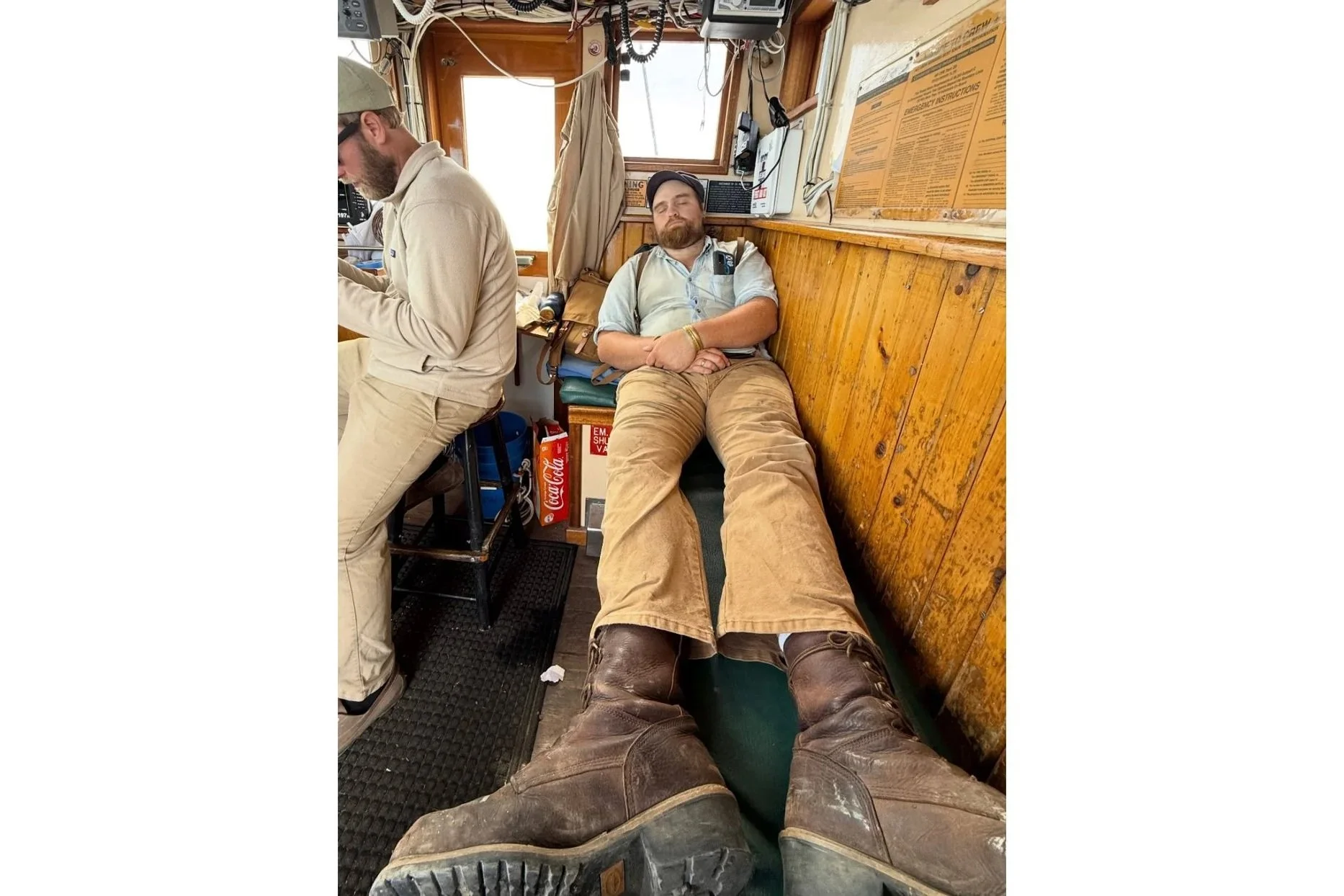
Caleb, a fellow deckhand, asleep in the wheelhouse of the Laura B., 2026.
A considerable distance separates a captain eating breakfast, a deckhand asleep in the wheelhouse, and the sailors I grew up admiring in paintings. I have loved Howard Pyle's and N. C. Wyeth's maritime illustrations since I was a child. Pirates, enormous ships, swords, elaborate costumes, extraordinary weather, and people behaving as though their lives depended upon whatever happened in the next few seconds. I am very fond of Pyle's pirates. There is something wonderful about how seriously he takes the whole business. His figures wear ridiculous clothes, strike dramatic poses, and generally behave as though the fate of the world rests on whatever they are doing. And somehow he makes you believe them. The pictures are theatrical, certainly, but the gestures have weight, the costumes seem to belong to the bodies wearing them, and everything has been arranged with sufficient conviction that the story becomes believable.
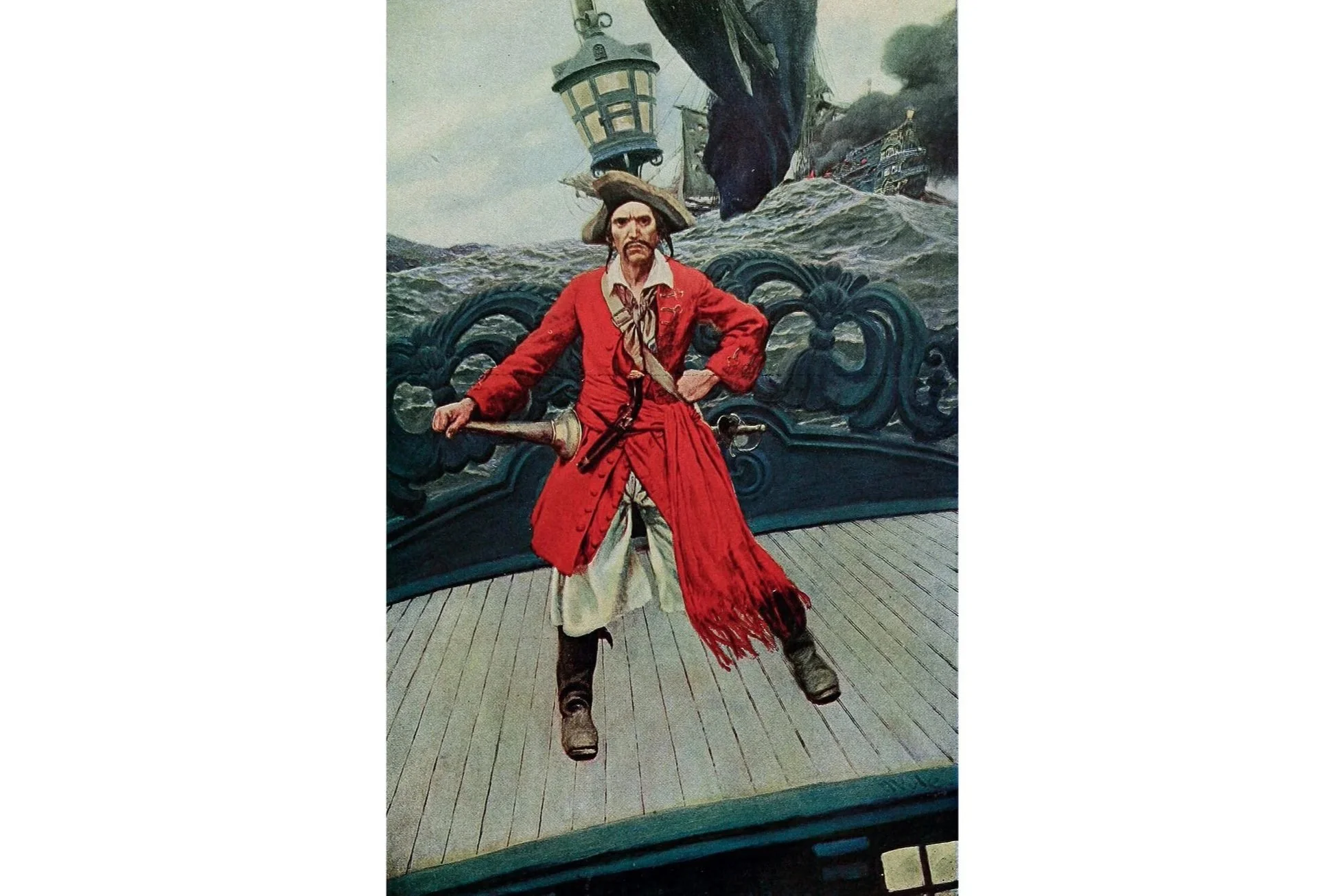
Howard Pyle, Captain Keitt, reproduced in Howard Pyle’s Book of Pirates (1921).
One painting by N. C. Wyeth that has interested me lately is The Roaring Skipper. Painted in 1914, it depicts a captain bound to the wheel of his ship, struggling against an enormous sea rising behind him. I have always liked the picture, partly because the skipper reminds me of a family friend named Skip Bracy, an old sea captain who once came to my rescue after I ran out of fuel in my own boat. But the painting also interests me because N. C. Wyeth makes the wheel the center of the action. The rigid geometry of its spokes contrasts with the violence of the surrounding sea, and the skipper's body appears caught between the two. Almost everything in the composition contributes to the impression of a man struggling to maintain control of his ship. Some of this arrangement has made its way into my own painting, though the figure's circumstances are quite different.
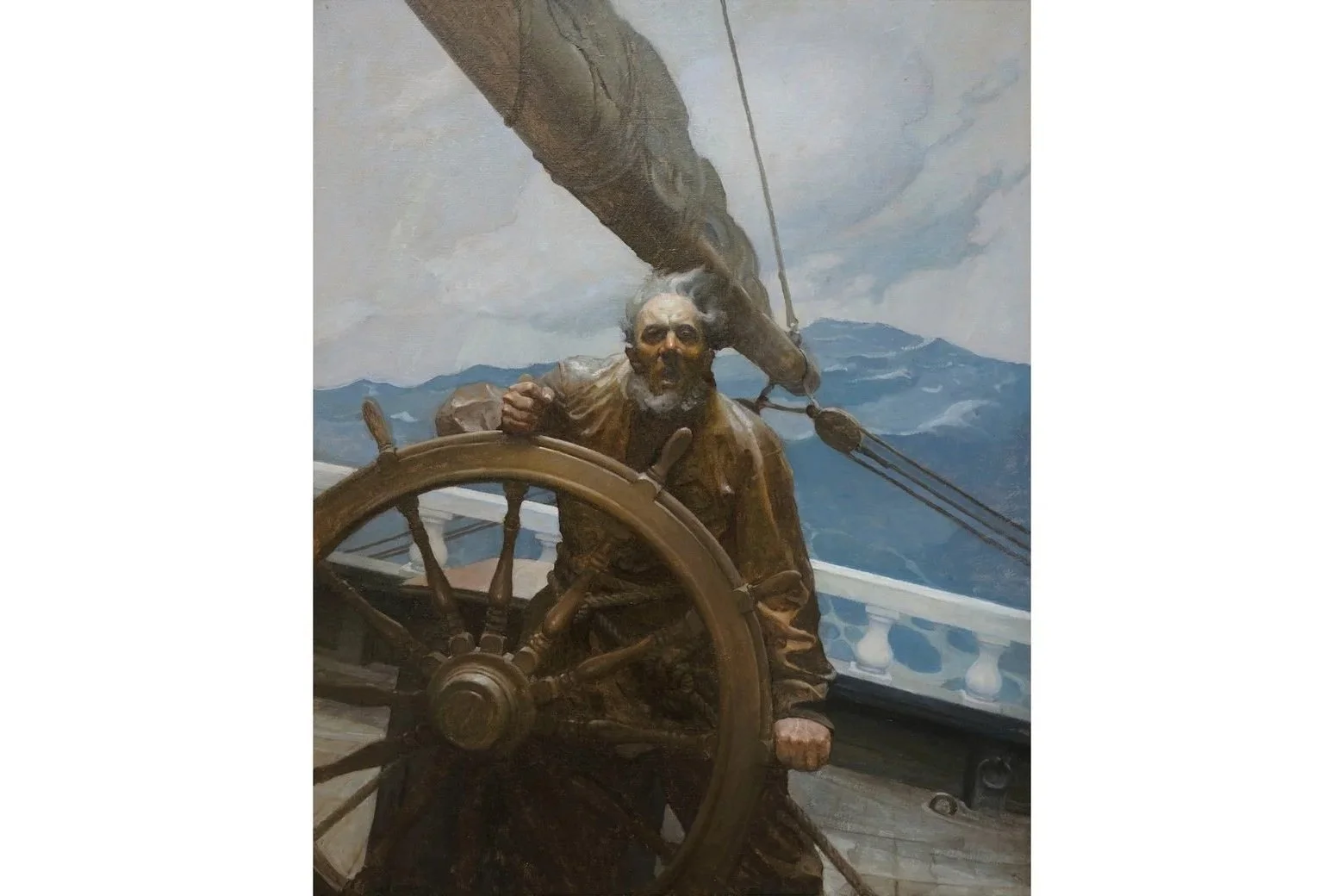
N. C. Wyeth, The Roaring Skipper, 1914, oil on canvas.
I've been thinking lately about another kind of painting, one that operates quite differently from the illustrations of Pyle and N. C. Wyeth. While their figures are often caught in moments of extraordinary action, the paintings of N. C. Wyeth's son, Andrew, often focus on moments when very little seems to be happening. The drama, if that is the right word, is harder to locate. His landscapes, empty rooms, and solitary figures are rendered with extraordinary conviction, but observation alone cannot account for the emotional experience of looking at them.
I have been thinking about Andrew Wyeth's Winter 1946. The painting depicts a boy running down a bare hillside, his body pitched forward, one arm reaching into the empty air. Nothing in the surrounding landscape explains his movement. No pursuer, no visible destination. His body seems almost carried along by the slope, and it is difficult to tell whether he is approaching something or fleeing from it. The bare hillside seems almost to swallow him.
The painting was made shortly after the death of Andrew's father, N. C. Wyeth, who had been killed in a railroad accident the previous year. Andrew later described the hill as, in some sense, a portrait of his father. It is a strange and moving idea, particularly because there is nothing in the literal appearance of the landscape that requires us to understand it that way. Knowing the circumstances changes how I look at the painting, but the boy's movement remains mysterious. Whatever Andrew intended, the hillside seems to contain more than its appearance suggests.
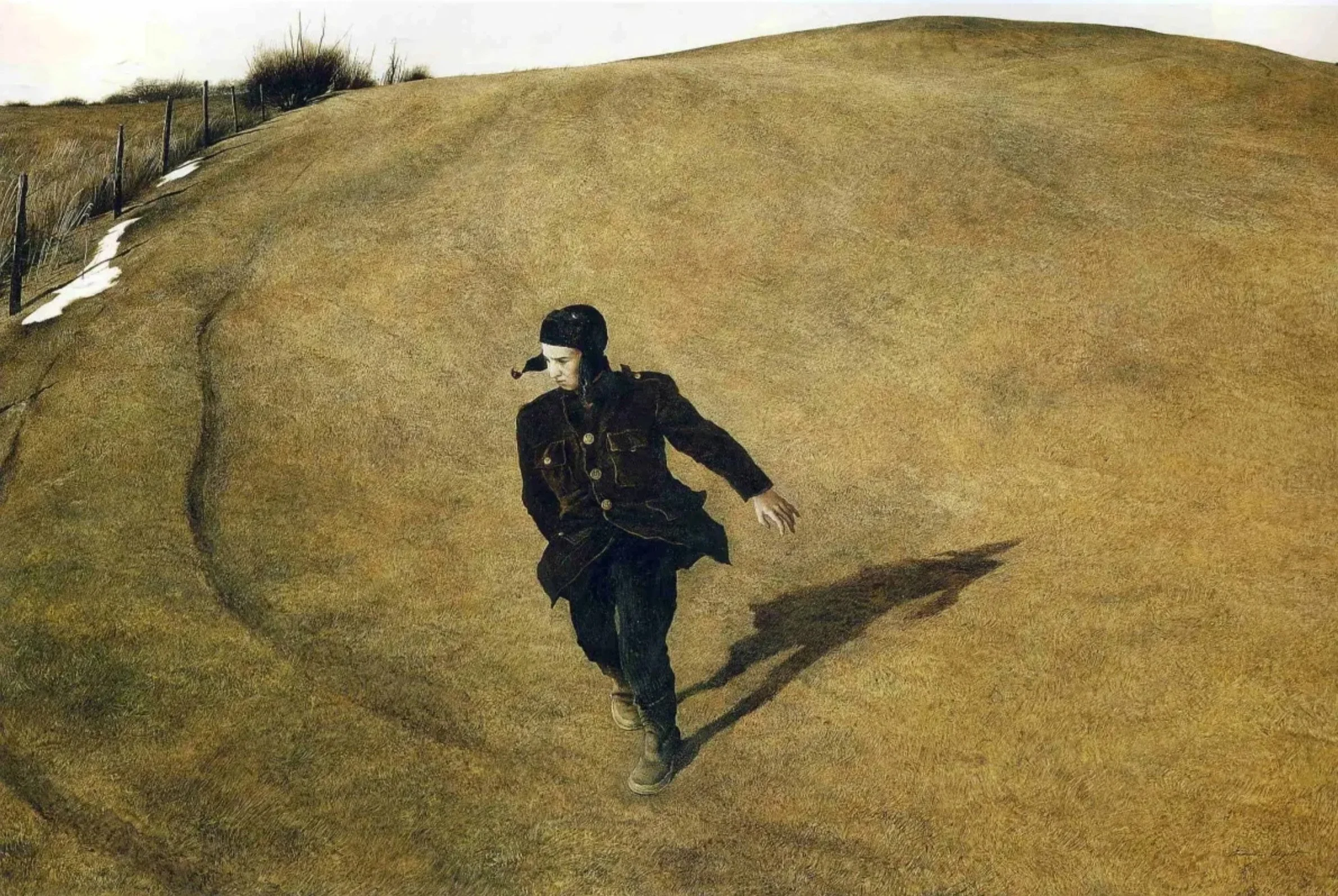
Andrew Wyeth, Winter 1946, 1946, tempera on board.
In paintings like these, familiar objects and places gain significance through their arrangement, isolation, or association with other things. The light is believable, the landscape is believable, and the people belong to a recognizable physical world. Yet the painting seems to concern something that could not have been observed directly. Realism gives the invention something to stand on.
What I love about Pyle and N. C. Wyeth is their willingness to make extraordinary things seem entirely believable. The costumes, the gestures, the enormous ships and impossible-looking seas. I have been looking at those pictures since I was a child, and I still find myself borrowing from them. But I am just as interested in Andrew Wyeth's paintings and Conrad's writing, where the outward appearance of a person often tells us very little about what he is actually experiencing. It took me some time to recognize how these interests might belong together.
Returning from Maine this autumn, I began making studies for a painting of a man at a ship's wheel. I had been looking through summer photographs, thinking about Conrad, and revisiting the illustrations I admired as a child. The earliest watercolor sketch borrowed rather freely from the maritime pictures I had been looking at. The figure wore a red coat and looked like a British soldier scratching his head, with a theatrical quality I admired in Pyle's pirates. He appeared puzzled, perhaps a little bewildered by whatever circumstances had brought him there. I liked the image, though I did not know exactly what to do with it.
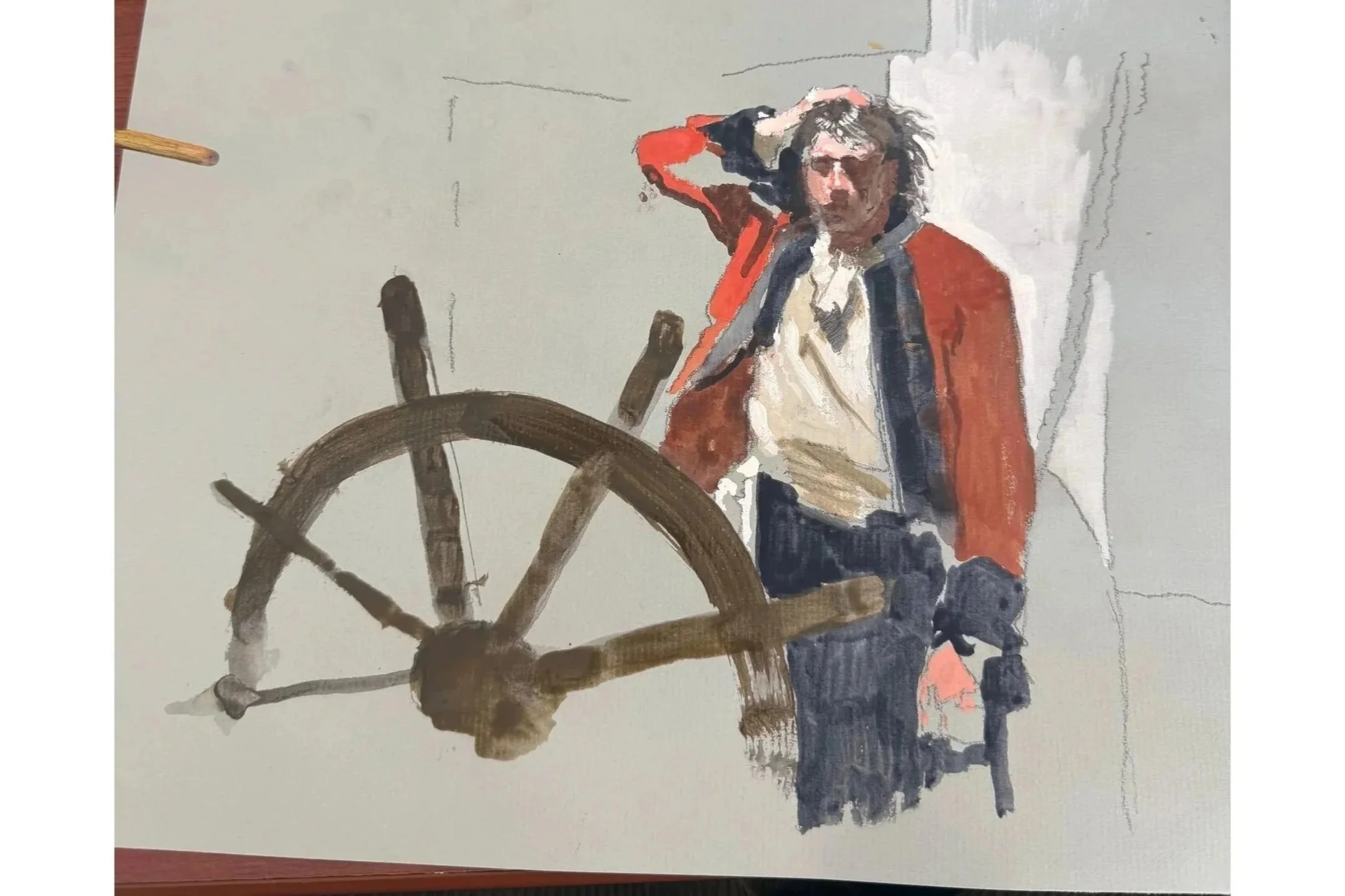
Untitled Study (preliminary study for The Shadow of the Patna), 2026, watercolor on paper.
As I continued developing the composition, I approached the subject differently. The wheel became much larger relative to the man, and I moved it behind the figure. The man, who had previously looked puzzled or uncertain, began to fold forward, his head lowered between two hands pressing hard against his temples. The wheel no longer seemed merely an object he was operating. It occupied so much of the composition that the man appeared almost diminished by it.
What had initially seemed like a moment of bewilderment was becoming something much harder to account for. The man no longer looked like someone confronted by an unexpected adventure. He looked as though something had already happened.
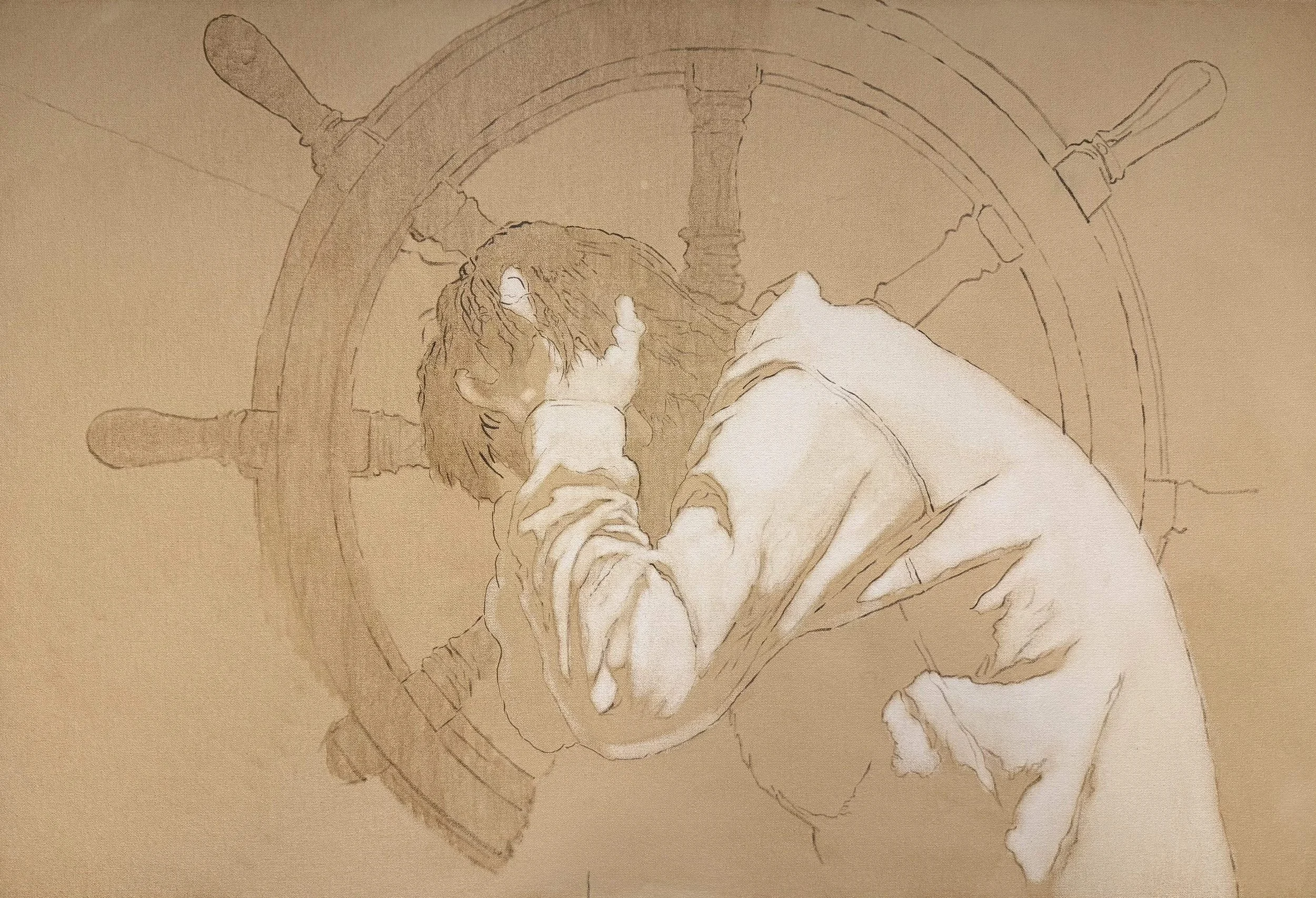
The Shadow of the Patna, 2026, oil on canvas (work in progress).
I have since begun painting under the title The Shadow of the Patna. It doesn't illustrate any particular passage from Lord Jim, nor am I trying to recreate the events of Conrad's novel. I am more interested in what Jim might be thinking. The ship's wheel has become central to the composition, though I haven't quite decided what to make of it. I know why I was originally drawn to the object, but its significance has changed as the painting has developed. I would rather leave some of those questions open than settle upon an explanation before the painting is finished.
The painting began with the visual language of maritime adventure, but gradually became concerned with something far less adventurous. Pyle and N. C. Wyeth often present their heroes at moments of extraordinary action, their gestures suggesting that they are equal to whatever circumstances confront them. Conrad's Jim is a less accommodating subject. He spends much of the novel suffering because he failed to act as the hero he had imagined himself to be.
I did not begin with any of this clearly worked out. The different influences began to suggest the same image as I made drawings, and I still don't know exactly when that happened.
I am not sure I could have arrived at this image by deciding in advance what I wanted it to mean. But letting a picture develop this way raises another difficulty: how do I know whether I am making something of my own, rather than borrowing too freely from the work of people I admire?
In July, I wrote about my fear of making dishonest paintings of the Maine coast. Certain subjects acquire ready-made significance with suspicious ease. Lobster boats, fog, gulls, weathered wharves—there is a great deal of romantic imagery available to anyone who wants to make a painting of Maine. The solution is not to avoid those subjects. They are part of the place, and it would be equally dishonest to pretend otherwise. But there is a responsibility to look at them for yourself. The same seems true of invention. I can borrow from Pyle, Wyeth, or Conrad, but eventually I have to make something that comes from my own experience. Otherwise, I am simply rearranging things that other people have already done rather well.
Another difficulty with this explanation is that it makes painting sound almost entirely like something that happens in my head. In reality, the image I initially imagine is rarely the image I end up making. A composition that seems convincing in a small study might look ridiculous on a larger canvas, or something that seemed important when I started becomes increasingly irrelevant as the painting develops. Occasionally, I discover that an idea I have spent months considering simply does not make a very good picture. This is disappointing, particularly after I have told several people about it.
The physical business of painting also produces ideas that thinking alone could never have supplied. A passage of color might suggest a different arrangement of light, or an awkward drawing forces me to reconsider a figure's position. Sometimes I scrape away an entire section and find that what remains is more interesting than what I intended to paint. Other times I scrape away an entire section and discover that I have accomplished very little. This autumn, I have been returning to several unfinished paintings, some of which have become harder to work on over time. I am trying to become less attached to what I originally imagined they might be, though I find myself reluctant to let go of the hopes I once had for them. It is possible to spend so long imagining a painting that you become reluctant to let the real thing interfere with your imagination.
For now, The Shadow of the Patna remains unfinished in my studio. A conversation with my godfather, a book I read over several years, working aboard the Laura B., and paintings I admired as a child all seem to have contributed to it. I have spent an unreasonable amount of time reading about the psychological circumstances of a fictional sailor, looking at pictures of pirates, and attempting to understand why I want to paint a man with his head in his hands. I have also written several thousand words about the subject when I probably ought to be painting it.
But I am still sick, and October is young.
Happy autumn, happy painting.
Gavin